
Family stories
Family stories
The stories behind the names
A family history is more than a list of names. Read about ancestral homes, leadership, journeys and the changes that shaped each generation. Historical books begin the story; family memories, photographs and carefully sourced contributions help bring it closer to the present.
Explore this page ↓
Explore memories of ancestral homes, migration and life today. Published stories are submitted by families and reviewed by the site administrator.
Stories behind the family names
Read approved historical summaries and family memories. Source chapters and the complete account are linked from each story.
Approved family history
Akoi — the Khangura chief family
The Akoi Khangura family’s source-recorded stem begins with Chanda and Narain Singh. This selected historical branch includes Ranjit Singh and his son Rajdev, alongside two other deceased family members.
Read the history & source chapters →Approved family history
Alawalpur — the Bains chiefly family
The Alawalpur Bains family traced its origins to Gulab Rai and Jalla. Himmat Singh served Nabha before entering Ranjit Singh’s service. The later branches held Alawalpur and Dhogri; this tree follows only the source-recorded historical relationships.
Read the history & source chapters →Approved family history
Ambala — the Nishanwalia chiefs
The Nishanwalia chiefs were associated with the Sikh confederacies and the Ambala region. This collection records early branches without treating every succeeding chief as a son of his predecessor.
Read the history & source chapters →Approved family history
Amrik Singh Hasanwala of Ramnagar
The Hasanwala account follows Ram Singh from Charat Singh’s household into long service under three Sukarchakia generations. His sons also entered Ranjit Singh’s forces and served in several campaigns. The narrative describes grants made for service and the later reduction or loss of portions of the family estate.
Read the history & source chapters →Approved family history
Arbel Singh, Sangatpuria Kanhaiya
The Sangatpuria branch is linked to Jassa Singh, an uncle of Hakikat Singh Kanhya. Charat Singh and his descendants shared the Kanhya confederacy’s campaigns and estates. After Ranjit Singh absorbed their territory, replacement grants and military appointments sustained the family, including later service in irregular cavalry and regular regiments.
Read the history & source chapters →Approved family history
Arjan Singh Chahal
Arjan Singh’s Chahal family first served the Bhangi chiefs at Lahore. Karam Singh later joined Ranjit Singh, received grants and became an important military officer. The chapter describes his campaigns and death at the battle of Teri, before following the succession of his son Gurmukh Singh.
Read the history & source chapters →Approved family history
Arnauli — the Bhai family
Arnauli preserves another branch of the Bhai family in the old Ambala region. Its later history includes service, estate life and education at Aitchison College. Family recollections can add context to these source-recorded connections.
Read the history & source chapters →Approved family history
Ashak Mahomed Khan of Multan
This chapter introduces the Badozai family of Multan through the wider history of its Afghan connections. Its opening surveys competing origin traditions and the family’s claimed ancestry. Those nineteenth-century discussions are historical testimony about identity, rather than proof of ancient descent; later portions of the chapter trace the family’s regional fortunes.
Read the history & source chapters →Approved family history
Attar Singh, Rosa
The Rosa account connects the family with a settlement near Chunian. Thakar Singh served Adina Beg and acquired territory after his death. Jodh Singh later entered Charat Singh’s service at Gujranwala and maintained Rosa settlements. The chapter follows changes in the estate as relations with neighbouring chiefs shifted.
Read the history & source chapters →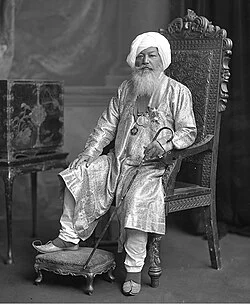 Baba Khem Singh Bedi · 1902
Approved family history
Baba Khem Singh, C.I.E.
The Bedi chapter places Khem Singh in the elder branch associated with Sahib Singh of Una and Bishan Singh’s move to Jalandhar. It describes disputes over estates and the differing positions taken by relatives during 1848–49. The account also records grants in the Jalandhar Doab and the area then called Pakpattan.
Read the history & source chapters →Approved family history
Baba Narotam Singh
This religious family’s Rawalpindi history is linked to Baba Mushtak Singh and Baba Khushal Singh. The account describes land grants from Milkha Singh Thepuria, the establishment of a gurdwara at Saidpur and connections with Amritsar. Later passages discuss the continuation or resumption of grants. A chart-and-prose discrepancy about Atar Singh’s relationship remains unresolved.
Read the history & source chapters →Approved family history
Badrukhan — the Phulkian chiefly branch
Badrukhan represents a collateral branch of Jind through Bhup Singh. This historical tree follows the Karam and Basawa branches; it distinguishes kinship from later succession to Jind.
Read the history & source chapters →For descendants, wherever life has taken you
Your family remembers what the books could not.
A missing name may be someone your grandparents remembered. An old photograph may be the only face a future generation ever sees. What feels ordinary to your family today can become a treasured part of tomorrow’s history.
Add a missing generation
Connect a parent, grandparent or branch you know.
Give a name a face
Share a family photograph, with permission and any known date.
Tell what happened next
Remember an ancestral home, school, journey or family tradition.
Start with one detail. You can return and add more. Include a source where possible, or clearly identify an oral memory. Submissions are reviewed before publication; living people’s details are shared only with their consent.
Help carry our story forward ↗