
Family stories
Family stories
The stories behind the names
A family history is more than a list of names. Read about ancestral homes, leadership, journeys and the changes that shaped each generation. Historical books begin the story; family memories, photographs and carefully sourced contributions help bring it closer to the present.
Explore this page ↓
Explore memories of ancestral homes, migration and life today. Published stories are submitted by families and reviewed by the site administrator.
Stories behind the family names
Read approved historical summaries and family memories. Source chapters and the complete account are linked from each story.
Approved family history
Shahabad chief family
The Shahabad family headed in the 1940 volume by Jasmer Singh is indexed under historical Karnal district. It is included in the wider Ambala and Cis-Sutlej collection for discovery, with its original district clearly identified. The pedigree starts with Himmat and Karam Singh and records the Ranjit, Sher and Kahan Singh branches.
Read the history & source chapters →Approved family history
Shahid family of Shahzadpur
The government volume includes the Shahid family of Shahzadpur among the Ambala district chiefs. Its pedigree links Karam Singh to the Gulab and Mahtab Singh branches, and follows Sheo Kirpal and Jiwan Singh to Ram and Kartar Singh. The family is represented as its own historical house rather than merged with unrelated people of the same name.
Read the history & source chapters →Approved family history
Shamsher Singh, Mari
The Mari family is described as a Shergill house that moved after the destruction of Mallanwala. Kaur Singh acquired territory with the Bhangi and Faizullahpuria chiefs and established a fort at Mari. Later negotiations with Ranjit Singh exchanged control of the fort and territory for other estates.
Read the history & source chapters →Approved family history
Shamshuddin Khan Kasuria
The Kasuria account connects Shamshuddin Khan’s family with trade near Kasur and service under its Afghan chiefs. After the loss of Kasur, family members moved with Kutbuddin Khan to Mamdot. Shamshuddin later acted as an agent at Lahore and for Lal Singh; the chapter’s interpretation of wartime diplomacy is the author’s account, not a neutral finding.
Read the history & source chapters →Approved family history
Sher Singh Kamla
The Kamla account follows Godh Singh and Utam Singh in the Bhangi confederacy. It relates an anecdote explaining the family’s nickname and describes the succession of Jai Singh to the estate. Jai Singh later entered Ranjit Singh’s service, connecting the family’s holdings with the new Lahore state.
Read the history & source chapters →Approved family history
Singhpuria — the Virk ruling family
The Singhpuria chiefs’ early family record includes Nawab Kapur Singh, his nephew Khushal, and Khushal’s son Budh. Budh’s sons are associated with seven later estates. This selected branch provides a starting point for documenting those connections.
Read the history & source chapters →Approved family history
Sirdar Chanda Singh Kalawalia
The Kalawalia account follows the estate established through Diwan Singh’s adoption by Hari Singh Bhangi. Dhana Singh and Jodh Singh later succeeded. The chapter describes Ranjit Singh’s absorption of part of the territory and a subsequent marriage connection between Jodh Singh’s daughter Khem Kaur and Prince Kharak Singh.
Read the history & source chapters →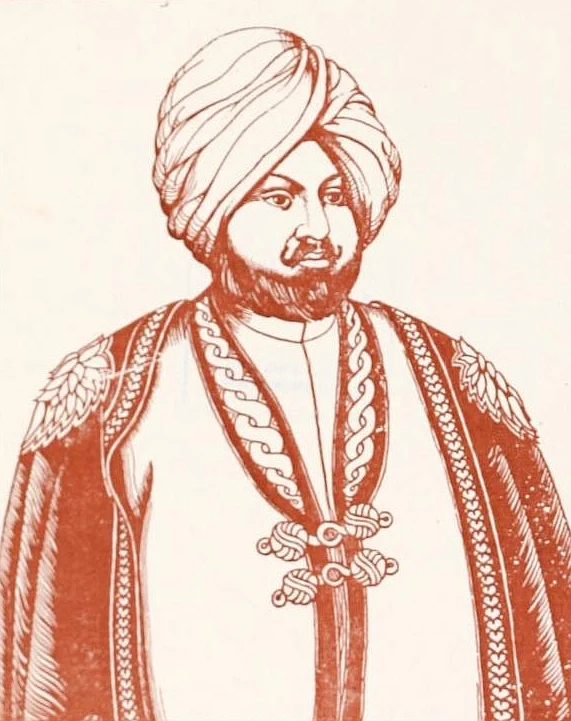 Sardar Dyal Singh Majithia
Approved family history
Sirdar Dyal Singh. Majithia
The book distinguishes three Majithia branches, represented by Dyal Singh, Surat Singh and Mehtab Singh. Dyal Singh’s branch is traced through Nodh Singh and Desa Singh. Desa Singh served the Bhaga chiefs before aligning with Ranjit Singh during the events of 1809, when new grants strengthened the family’s position.
Read the history & source chapters →Approved family history
Sirdar Fatah Singh, Thepuria
Milkha Singh Thepuria is described as a powerful chief who founded Thepur and acquired territory further north. He established headquarters at Rawalpindi and developed the town despite its exposed position on the invasion route. After his death, Ranjit Singh confirmed the estate to his son Jiwan Singh, linking the later family with this regional legacy.
Read the history & source chapters →Approved family history
Sirdar Gulab Singh Powindia
Gulab Singh Powindia entered Ranjit Singh’s service after the family lost its earlier holdings in the Jalandhar Doab. He advanced through command appointments and received grants for military service. The narrative follows his campaigns, frontier responsibilities and the entry of his son Ala Singh into the army.
Read the history & source chapters →Approved family history
Sirdar Kahn Singh, Attariwalia
The Attari chapter places the family among the chiefly houses of the Majha and discusses its claimed origins and relations with the Sindhanwalias. It records a royal marriage connection through Nanaki Kaur and Prince Nau Nihal Singh. The author’s ranking of communities reflects nineteenth-century social assumptions and is not adopted here.
Read the history & source chapters →Approved family history
Sirdar Kahn Singh, Nakkai
The Bahrwal Nakai chapter opens with a tradition of Guru Arjan’s visit and the hospitality of a local headman. This religious story explains the family’s remembered connection with Bahrwal. The accompanying pedigree places Kahn Singh within the Nakai house and records marriage connections with other leading families, including Ranjit Singh’s household.
Read the history & source chapters →For descendants, wherever life has taken you
Your family remembers what the books could not.
A missing name may be someone your grandparents remembered. An old photograph may be the only face a future generation ever sees. What feels ordinary to your family today can become a treasured part of tomorrow’s history.
Add a missing generation
Connect a parent, grandparent or branch you know.
Give a name a face
Share a family photograph, with permission and any known date.
Tell what happened next
Remember an ancestral home, school, journey or family tradition.
Start with one detail. You can return and add more. Include a source where possible, or clearly identify an oral memory. Submissions are reviewed before publication; living people’s details are shared only with their consent.
Help carry our story forward ↗