
Family stories
Family stories
The stories behind the names
A family history is more than a list of names. Read about ancestral homes, leadership, journeys and the changes that shaped each generation. Historical books begin the story; family memories, photographs and carefully sourced contributions help bring it closer to the present.
Explore this page ↓
Explore memories of ancestral homes, migration and life today. Published stories are submitted by families and reviewed by the site administrator.
Stories behind the family names
Read approved historical summaries and family memories. Source chapters and the complete account are linked from each story.
Approved family history
Jawahir Singh, Rasaldar-Major, of Chotala
The Chotala family is described as a Suri Khatri house with a long tradition of military service. Sultan Singh served in Ranjit Singh’s cavalry and received land and honours. Bishan Singh later held artillery responsibilities and entered the Punjab Irregular Cavalry after annexation. The narrative places Jawahir Singh’s career within that succession of service.
Read the history & source chapters →Approved family history
Jawahir Singh, Subadar (the late)
The chapter follows a Wirk family whose power and estates became tied to service under Ranjit Singh. Bhag Singh commanded the Wirkayat Horse; Jodh Singh succeeded him and died in the Kashmir expedition of 1814. Sahib Singh and Jawahir Singh later held military and local offices. The book’s account ends with the widows and remaining family land as recorded in 1890.
Read the history & source chapters →Approved family history
Jhanda Singh Philuwasia
The brief Philuwasia account records military service by Amir Singh, Karam Singh and the next generation. It describes the loss of some grants after relatives joined the opposing forces in 1848, while another branch retained a grant. The prose names several people without providing a complete, unambiguous pedigree.
Read the history & source chapters →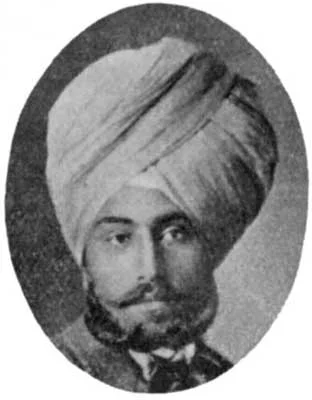 Maharaja Ranbir Singh of Jind
Approved family history
Jind royal family
Jind is a Phulkian house descending in the published pedigree from Phul through Tiloka and Sukhchain. The chart includes Gajpat Singh, Bhag Singh and Fateh Singh, and a collateral branch through Bhup and Karam Singh leading to Sarup Singh and the later rulers. It also identifies the Basawa Singh branch associated with Nabha.
Read the history & source chapters →Approved family history
Jit Singh, Rukhanwala Kanhaiya
The Kanhya chapter connects the confederacy’s name with Jai Singh’s village of Kana. Jai Singh and his brother Jhanda first served Kapur Singh, then assembled their own force and acquired territory. Their expansion provides the setting for the later family branches represented by Jit Singh and his relatives.
Read the history & source chapters →Approved family history
Jiwan Singh, Bikhi
The Bikhi family is associated with hereditary local office before Sahib Singh and Sahai Singh became Sikhs and acquired territory around Sheikhupura. Their descendants resisted Ranjit Singh before surrendering the fort and receiving replacement estates. The chapter follows later military appointments and the redistribution of the family holdings.
Read the history & source chapters →Approved family history
Jodh Singh Chhapawala
The Chhapawala family is traced through Dyal Singh’s service under Tara Singh Kanhya. After Dyal Singh’s death and the loss of his grant, his sons Kishan Singh and Ran Singh entered Ranjit Singh’s service. Their cavalry commands and relationship with Prince Kharak Singh brought new responsibilities and estates.
Read the history & source chapters →Approved family history
Kahn Chand
Kahn Chand’s family is traced from Multan into clerical, revenue and military employment. Kahn Chand entered government service as a secretary and later handled official dispatches. The chapter describes his work alongside senior court figures and his involvement in raising the Dera Khas, though he did not command it.
Read the history & source chapters →Approved family history
Kaithal — the Bhai chiefs
The Bhai house governed Kaithal in the Cis-Sutlej region. This tree follows the branch through Desu Singh and Lal Singh to the nineteenth-century chiefs. Help preserve the story with family papers and dated photographs.
Read the history & source chapters →Approved family history
Kalsia ruling family
Kalsia was one of the Cis-Sutlej chiefships, associated with Chhachhrauli and the wider Ambala region. Its published pedigree begins with Gurbakhsh Singh and Jodh Singh and then separates the Sobha, Hari and Karam Singh branches. The ruling line through Lehna and Bishan Singh is distinct from Man Singh’s collateral line.
Read the history & source chapters →Approved family history
Kanaiti — the ruling family
Kanaiti lay between Narkanda and Kotguru and was a tributary of Bashahr. Its chief also held Deori. The chapter describes an agreement in 1886 to replace revenue collected in kind with cash payments, and the pedigree follows Nain Chand’s descendants.
Read the history & source chapters →Approved family history
Kandhola — the Virk chief family
Kandhola developed as a branch of the Singhpuria Virk family after Budh Singh’s estates passed to his sons. The source traces Dyal Singh’s descendants through Bishan, Harbans, Bhagwan and Atamainder Singh, alongside the Kishan and Kehar branches. Bhagwan and Atamainder are reported to have studied at Aitchison College, Lahore. Later descendants can contribute documented additions with permission from the people concerned.
Read the history & source chapters →For descendants, wherever life has taken you
Your family remembers what the books could not.
A missing name may be someone your grandparents remembered. An old photograph may be the only face a future generation ever sees. What feels ordinary to your family today can become a treasured part of tomorrow’s history.
Add a missing generation
Connect a parent, grandparent or branch you know.
Give a name a face
Share a family photograph, with permission and any known date.
Tell what happened next
Remember an ancestral home, school, journey or family tradition.
Start with one detail. You can return and add more. Include a source where possible, or clearly identify an oral memory. Submissions are reviewed before publication; living people’s details are shared only with their consent.
Help carry our story forward ↗