
Family stories
Family stories
The stories behind the names
A family history is more than a list of names. Read about ancestral homes, leadership, journeys and the changes that shaped each generation. Historical books begin the story; family memories, photographs and carefully sourced contributions help bring it closer to the present.
Explore this page ↓
Explore memories of ancestral homes, migration and life today. Published stories are submitted by families and reviewed by the site administrator.
Stories behind the family names
Read approved historical summaries and family memories. Source chapters and the complete account are linked from each story.
Approved family history
Lala Ganda Mal
This chapter follows administrators whose family moved from Afghan service into Punjab. Gutu Mal served Gujar Singh Bhangi and Sahib Singh as diwan; Ram Kaur succeeded him. After Ranjit Singh absorbed Sahib Singh’s territory, members of the next generation obtained Lahore appointments, revenue responsibilities and estates linked to service.
Read the history & source chapters →Approved family history
Lala Ram Dayal
Lala Ram Dayal’s family is traced to Lachhi Ram’s settlement at Hafizabad. Gurdit Singh entered Prince Kharak Singh’s cavalry, while marriage connections linked the family with Sawan Mal’s household. Harsukh Rai held judicial, military and revenue appointments at Multan and Lahore, illustrating the family’s movement between different forms of state service.
Read the history & source chapters →Approved family history
Madhan — the ruling family
Madhan comprised villages near Phagu and Matiana, on the route from Shimla towards Kotguru. It paid tribute to Keonthal. The chart includes the ruling branch through Nikal Chand, Sansar Chand and Bishan Chand, together with collateral branches.
Read the history & source chapters →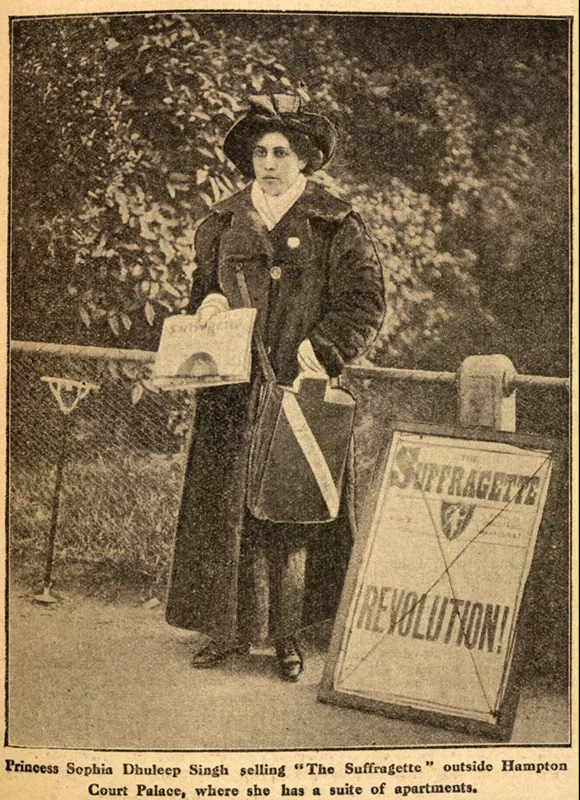 Princess Sophia Duleep Singh · campaigning for women’s suffrage, 1913
Approved family history
Maharaja Ranjit Singh’s family
The royal-family appendix records Ranjit Singh’s marriages, children and related households. It connects marriages with the Kanhya, Nakai and other chiefly families and records later allowances for members of the household. The author makes disputed claims about parentage; these remain attributed and uncertain. This royal tree is not a claim that every Punjab family descends from Ranjit Singh.
Read the history & source chapters →Approved family history
Maheru — the Mann chiefs
Maheru’s early Mann family is recorded across several generations of estate holders. The source describes the transition from an independent chiefship to a jagir under the Lahore government.
Read the history & source chapters →Approved family history
Mahlog — the ruling family
Mahlog, printed as Mailog, lay near the foot of Kasauli Hill between Nalagarh and Kuthar. Sansar Chand took refuge with the ruler of Nalagarh during the Gurkha occupation and was restored in 1815. The pedigree continues through Dalip Chand to his son Raghnath Chand, who succeeded in 1880.
Read the history & source chapters →Approved family history
Mahomed Amir Ali Khan, Kharal
The Kharal chapter associates the family with Kot Kamalia and the wider Gogaira, Jhang and Lahore region. It identifies Kamal Khan as an early figure in the account and describes conflict over territory, including relations with the Sials. The author’s hostile generalisations about communities are period prejudices and are not adopted in this summary.
Read the history & source chapters →Approved family history
Mahomed Ismail Khan, Sial
The Sial chapter describes the chiefs of Jhang as an important power along the Chenab before Ranjit Singh’s ascendancy. Its opening recounts traditions of Rajput origins, migration and conversion associated with Baba Farid. These traditions provide context for the family’s remembered past but should not be treated as independently established ancestry.
Read the history & source chapters →Approved family history
Makhdum Bahawal Bakhsh, Kureshi
The Multan chapter centres on the family associated with Bahauddin’s religious legacy and custodianship of the shrines of Bahauddin and Rukn Alam. It describes the influence of Makhdum Shah Mahmud and recounts traditions of Bahauddin’s learning, travels and settlement at Multan. Spiritual succession and family descent should be distinguished when reading the account.
Read the history & source chapters →Approved family history
Malaudh Phulkian family
The Malaudh family is a Phulkian branch associated with the Ludhiana region. The pedigree distinguishes Bakht Mal, a son of Rama, from other similarly named members of the broader Phul family. It follows Man Singh and his sons Dalel and Bhag Singh, and includes Badan Singh and the Dal Singh branch.
Read the history & source chapters →Approved family history
Malik Aulia Khan of Pindi Gheb
The Pindi Gheb account follows the Jodhra chiefs and their settlements near the Indus. Aulia Khan and Amanat Khan held substantial territory while paying tribute to the Sukarchakia chiefs. The chapter then describes Nawab Khan’s changed relationship with Ranjit Singh and the consequences of his resistance in 1813.
Read the history & source chapters →Approved family history
Malik Fateh Sher Khan, Khan Bahadar, of Mitha Tawana
The Mitha Tiwana chapter relates the family to the wider histories of the Sials and Ghebas. It opens with alternative accounts of their common ancestry and explains that the genealogical traditions had changed over time. The recent Tiwana pedigree is therefore kept separate from the long and uncertain origin narratives.
Read the history & source chapters →For descendants, wherever life has taken you
Your family remembers what the books could not.
A missing name may be someone your grandparents remembered. An old photograph may be the only face a future generation ever sees. What feels ordinary to your family today can become a treasured part of tomorrow’s history.
Add a missing generation
Connect a parent, grandparent or branch you know.
Give a name a face
Share a family photograph, with permission and any known date.
Tell what happened next
Remember an ancestral home, school, journey or family tradition.
Start with one detail. You can return and add more. Include a source where possible, or clearly identify an oral memory. Submissions are reviewed before publication; living people’s details are shared only with their consent.
Help carry our story forward ↗